No strip-off
The existing covering stays in place. No skips, no waste disposal and no days with the building open to the weather.
The system
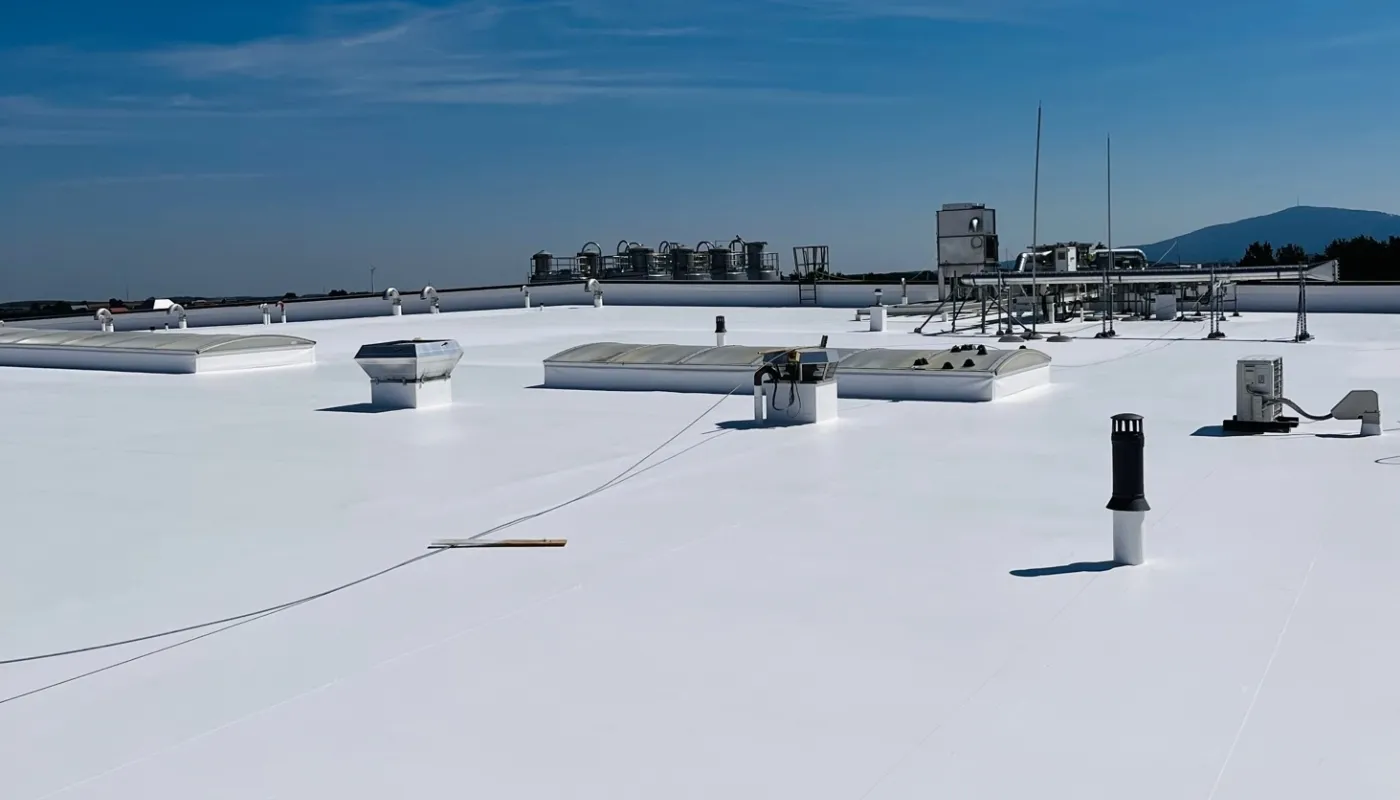
A liquid-applied flat roof waterproofing system that cures into a seamless membrane, formed in place on the existing roof. The complete build-up is certified under a European Technical Assessment.
The build-up
The first layer bonds the system to the roof: HYDRONYLON HP on felt, HYDRONYLON HMS(P) on metal and Primer Emulsion EG on mineral substrates. On PVC membranes the top coat is applied directly through the mesh.
The mesh is embedded into the wet liquid layer, giving the cured membrane its strength at outlets, upstands and junctions and across full surfaces. Overlaps are at least 10 cm on felt and 5 cm on PVC.
The finishing layer forms the final weathering surface of the system, in light grey, QLR ONE white or graphite. The base layers are never left exposed: the build-up is always completed with HN.
The approach
The existing covering stays in place. No skips, no waste disposal and no days with the building open to the weather.
The liquid cures into one continuous membrane formed in place. There are no joints or welds, the points where sheet systems fail.
No flames and no hot works on the roof: cold applied liquid roofing suited to occupied buildings across London.
Assessed as a complete system, with external fire performance B(roof)(t1).
The process
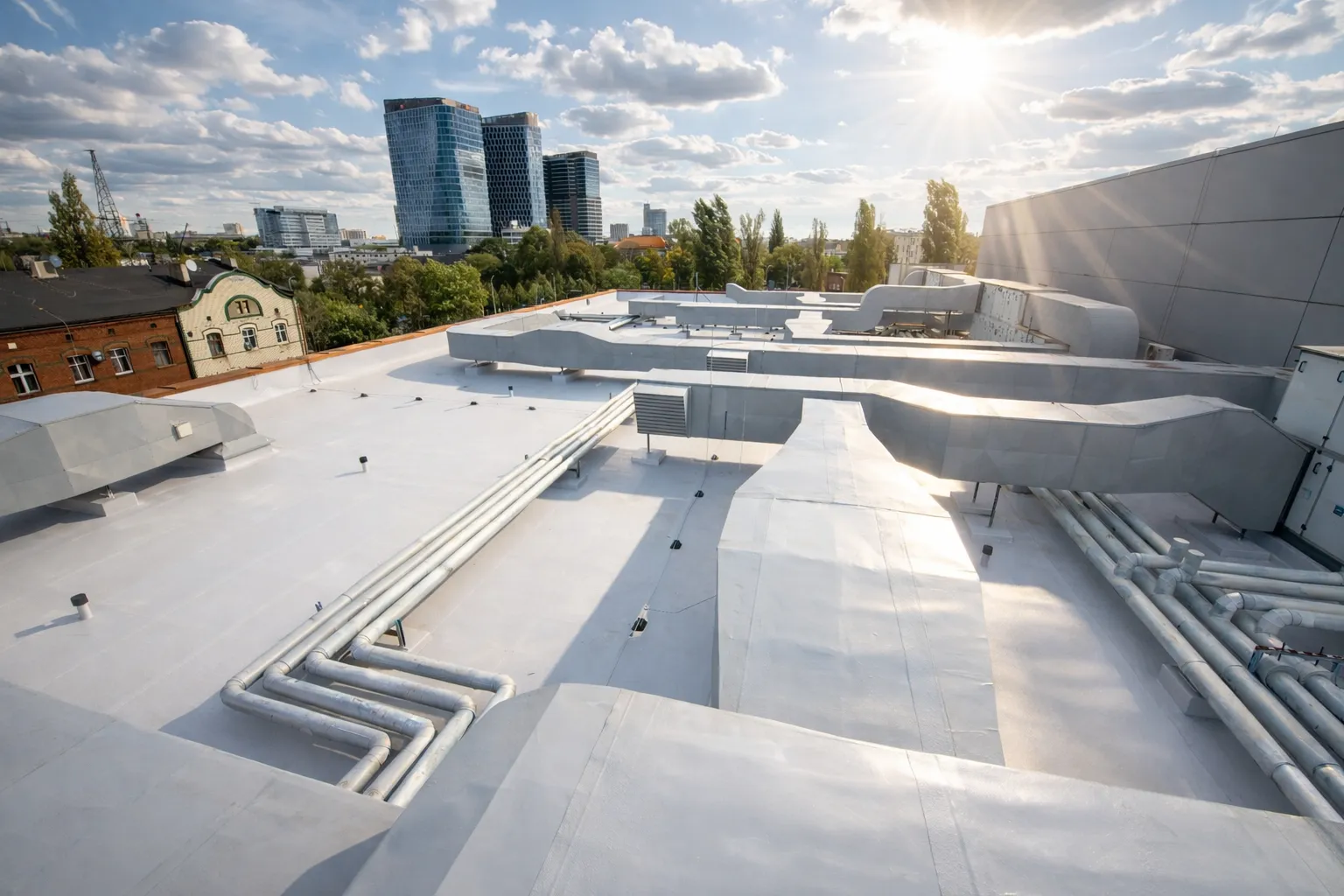
An Approved Contractor inspects the roof, identifies the substrate and confirms that the existing covering is sound enough to stay in place.
The surface is cleaned and local defects are made good. The substrate is then primed: HYDRONYLON HP on felt, HYDRONYLON HMS(P) on metal or Primer Emulsion EG on mineral decks.
The liquid layers go on at +10°C to +35°C, maintained around the clock, at relative humidity up to 85% and onto a dry substrate. The base is applied in a minimum of two coats where specified, with Technical Mesh SW-1 embedded, and each coat cures for at least 24 hours before the next.
The completed roof is signed off and backed by a 10-year product guarantee issued by HYDRONYLON LTD to the Approved Contractor. Ask your Approved Contractor about the guarantee terms.
Certification
| External fire performance | B(roof)(t1) |
|---|---|
| Reaction to fire | Class E |
| Watertightness | Watertight |
| Wind load resistance | Pass (> 50 kPa) |
| Working life category | W3 (25 years) |
| User load category | P3 (Normal) |
| Roof slopes | S1 to S4 |
| Surface temperature range | -20°C (TL3) to +80°C (TH3) |
| Minimum dry film thickness | Felt 1.8 mm, metal 0.7 mm, mineral 0.75 mm, PVC 1.2 mm |
| Notified Body | No. 1454 (Łukasiewicz - Warsaw Institute of Technology) |
Durability
The durability of the system is 25 years, an independently assessed working life. Completed projects are backed by a 10-year product guarantee issued by HYDRONYLON LTD to the Approved Contractor.
Approvals
The HYDRONYLON system is assessed under European Technical Assessment ETA-23/0735.
| External fire performance | BROOF(t1) |
|---|---|
| Reaction to fire | Euroclass E |
FAQ
No. HYDRONYLON is a liquid-applied roof waterproofing system: a multi-layer build-up with a base layer matched to the substrate, Technical Mesh SW-1 reinforcement and the HYDRONYLON HN top coat, assessed as a complete system. A single decorative layer has no reinforcement, no specified film thickness and no assessed working life; the system has all three.
The system is applied at temperatures between +10°C and +35°C, maintained around the clock, at relative humidity up to 85% and onto a dry substrate, never during rainfall. When overnight temperatures fall below +10°C, the work waits for a suitable weather window; your Approved Contractor plans the programme around the forecast.
The minimum dry film thickness depends on the substrate: 1.8 mm on felt, 0.7 mm on metal, 0.75 mm on mineral decks and 1.2 mm on PVC membranes, as assessed under its European Technical Assessment.
Yes. The system achieves external fire performance B(roof)(t1) and reaction to fire class E. It is also cold applied, so there are no flames or hot works on the roof during installation.